Blood Moon Pact - Review Pt. 1 - Player
The Preamble
Blood Moon Pact is a Jubensha (a form of immersive, scripted, murder mystery roleplaying game originating in China) for 6 players. It's a bit like a murder mystery party if the emphasis was placed more on a compelling story and high emotional stakes, instead of campy roleplaying and "escape room" like puzzle solving (which is also very fun, don't get me wrong). Set in a dark fantasy world with Orcs, Elves, and magic, you and 5 other players will attempt to figure out who has committed a murder before time runs out. Did you do it? One of your fellow players? Or perhaps someone else entirely? The setting is well realized through each of the player booklets. There are 6 total booklets (one for each player) that help guide you through the 4-5 hour experience.
I backed Blood Moon Pact on Kickstarter after hearing about it through Quinn's Patreon. I've been playing TTRPGs now for about 5 years and mostly play as a GM but have been getting more opportunities to play thanks to my online play group. I'd been curious about Jubensha since watching the People Make Games video on it. I was quite excited to learn that there was an English language game being made (and Canadian to boot)!
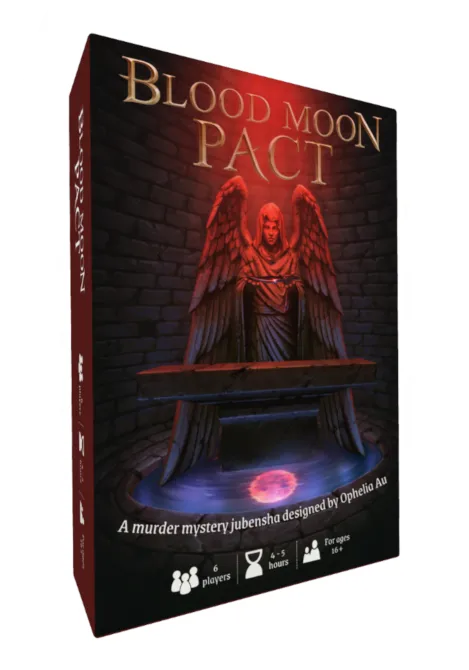
Ophelia Au (author of the game), offered to run some online sessions for backers mainly as a way for GMs to try it out before running it. I can't thank her enough because this was a truly invaluable experience.
A couple things to keep in mind:
- We played online which Ophelia admits isn't the ideal experience. That means I can't comment on the physicality of the game like best ways to set things up, flow, etc.
- None of us knew each other ahead of time. This wasn't an issue at all, but worth noting.
- I had my physical cards and booklet with me, but we did have digital play aids.
- I'm going to try and keep things fairly general so as not to spoil stuff, but there will be some spoilers for the Orc as well as the overall structure of the game.
- For this impression, I've purposefully not read the other booklets yet. I'll be running the game and creating a separate review later!
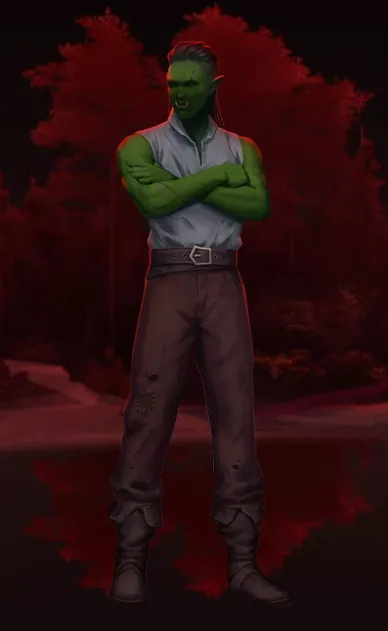
An Orc on the Run
I didn't have much of a preference as to who I'd play, and ended up with the Orc. The game requires 5 players and a GM to function and you get the choice between the Mercenary, Dryad, Elf, Orc, Prophet, and Scholar (GM). The Scholar role is a unique one as it's the character that the GM plays throughout the game. They have a card that indicates when they're speaking as "GM" and when they're speaking as "Scholar." It really can't be played without all of them as clues are linked to the characters and their actions.
We ended up using the generic titles in our playthrough (so I was just "Orc"). In person, it's probably easy enough to come up with names since it'll be obvious who you're speaking to, but online we needed to have clear, unmistakable names to cue each other.
The game is split into five Acts. Playing with Ophelia was quite neat as she was able to give us some game design insights as to the purpose of each act.
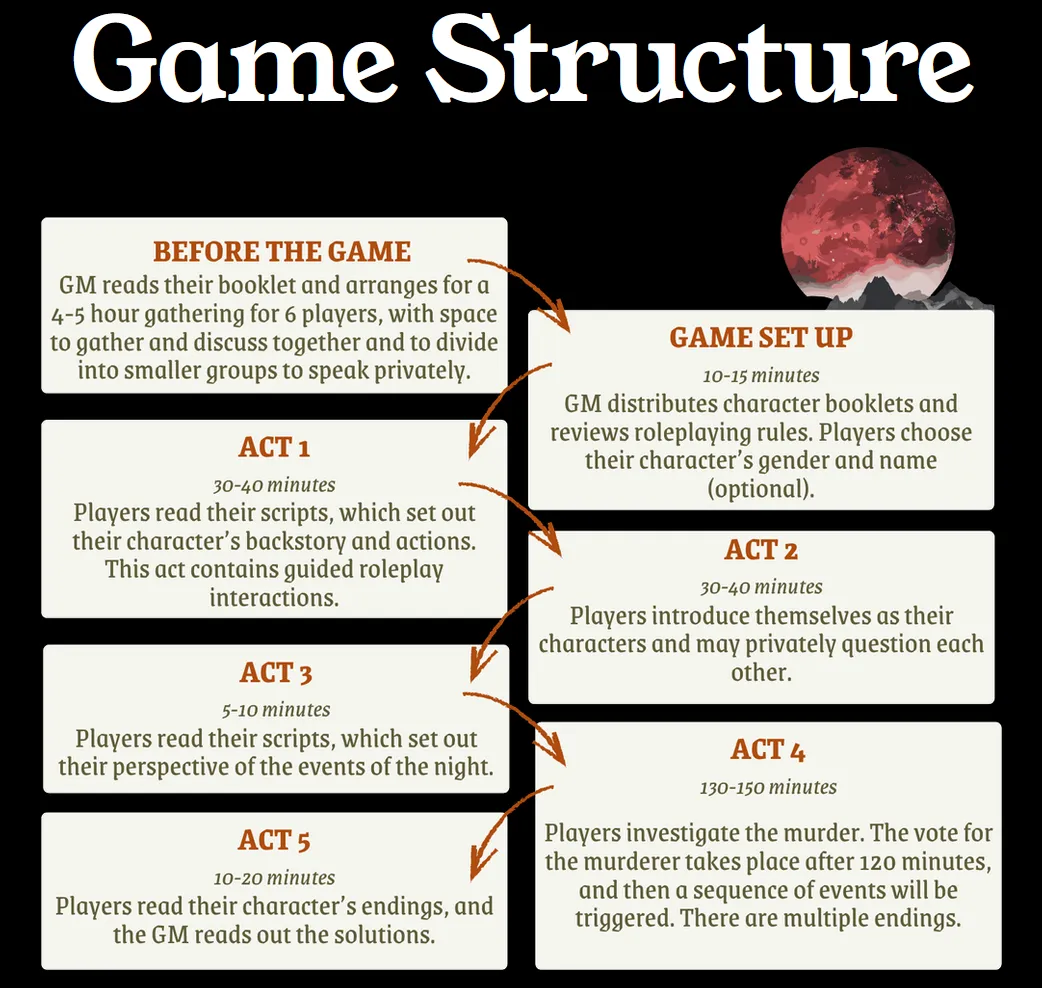
Let's dive into each act!
Act 1: Sunset
Act 1 is mainly reading that gives you your background and most characters receive a small scene to play out to help establish connections and character motivations. The Orc doesn't have a scene with another player, but does get a bit of extra information from the GM. You end up with a timeline of important events in your life written with just enough detail to make them feel real for you. I felt like I had a solid idea of who my character was and what mattered to them.
Now, one little quibble is that while I had excellent information about who I was, I didn't have a lot of actionable information. What I mean by this is info on how to effectively act like my character. I peeked at the front of the Scholar booklet after, and there are some descriptions of the characters that I think would be useful to have in the booklets or at least offered by the GM. For the Orc, it reads: "aloof, dominant, and ruthless." This is what I'd call actionable information. These are adjectives that can be acted. I can play aloof, but cannot necessarily play "exiled from my community".
This is something taught to me during my Masters in theatre directing. Imagine we're in a scene where someone has discovered their partner is cheating on them. If you just say: "they cheated on you," you'll get a wide variety of reactions. Maybe sadness, anger, denial, etc. If instead you tell the actor: "you feel dissociated, like you're not in your body, cold, distant, unmoored." You will now get a far more specific performance. Obviously, we're not trying to dictate the play by play reactions of characters in a roleplaying game, but general descriptions of behaviour like this can really help players grab on to something they can perform.
I think future games might benefit from adding not just "tasks" and "secrets", but "techniques", "behaviours" or something to that effect. For example, "try and dominate the conversation" or "act offended by too many questions". This might be too heavy handed, but I think if phrased as suggestions it could give people some real meat to chew on when roleplaying.
Act 2: Moonrise
By the end of Act 1, I was given a clear goal and a secret to keep. This act had all of the players meeting together for the first time which led to some fun roleplaying. We were then given 25 minutes to pursue our goals and gather as much intel as we could. This is mainly a warm up and a chance to remind you that you have goals to pursue and that the answers lie with the other players.
We were given a map and had some breakout rooms that we could go into to simulate private conversations. In person, this would be a bit easier to just physically walk away, but the breakout rooms actually worked quite nicely. Probably a bit harder for the GM to see if anyone needed help though.
This is also where a bit more notes on my personality might have helped as I think I may have played my character a bit too...eager and sincere. Maybe this isn't ultimately a problem? To be fair, the Orc is a rather physical role and being online did make it feel a bit tougher to embody some of those elements. This is likely just my insecurity that I wasn't performing the role as well as I'd like. I think that is in part why Act 2 exists. It's a chance to test out who your character is and get your feet under you before things get serious.
Act 3: Moon's Peak
This act was mainly reading and I remember saying: "well, holy shit" as I learned more about the events of the night. Luckily, I was muted. It's basically a page and a bit of extremely loaded information that changes the dynamics drastically. It was the kind of thing that gets you to lean forward in your seat in anticipation. I was rearing to start discussing again and by the reactions of the other players, they were equally ready.
Act 4: Moonset
This is where the game kicks into high gear. You're given a few tasks, some items (which you can share or not, but it's intended that you eventually share them), and a bit more info about yourself.
This was where we bumped up against some of the limitations of being online. In person, it becomes quite clear who hasn't shared the items they have (they'd be holding them after all) and one of the behaviors I was meant to do was a physical proximity task. Basically, I just couldn't do it online. I was able to somewhat verbalize it, but it would be much more obvious in person. It didn't become a problem, but if you're intending to run this online, it's something to flag.
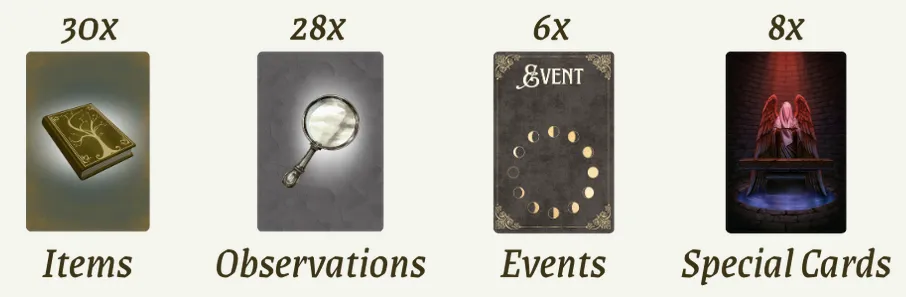
Throughout this act there are a series of timed events, book pages, items, observations, and blessings to uncover. They often connect to one another and are why you can't run this with fewer, or more, than 6 people. Ophelia mentioned that it's intended for all the information to come out before the timer ends and I think it's a useful thing to mention to the players. It was enough of an encouragement that we didn't feel like we had to just immediately reveal our info, but did make sure that we at least eventually revealed it.
Ophelia used a Canva board to post images of the cards as they were revealed. This is part of the challenge when playing online and would probably be easier using something like Foundry or any other VTT that supports handing out cards privately and revealing them (though that can be time consuming to set up). It really wasn't much of an issue though, just a little fiddly online. If you do use Canva, so long as everyone is logged into an account, they can paste the cards in themselves which was super convenient!
I need to tip my hat to Ophelia with this act. The slow reveal of information kept things incredibly engaging. There wasn't a single moment where we weren't sure how to proceed. It felt like revelation after revelation, with setbacks in between, until we had a huge eureka! moment literal seconds before the clock ended. I'll discuss this when I do an eventual GM review of it, but suffice to say, it was a truly incredible moment.
Act 5: Sunrise
There are actually a few different possible endings, though Ophelia mentioned that the GM really is trying to guide you to the "true ending". Having the other negative possibilities did make it feel like we actually accomplished something, so I think that was a wise choice. It also didn't feel like we were being inevitably led to the ending so much as gently guided.
The final moments aren't quite as impactful online, but I suspect it's a pretty epic and engaging finale in person. I had the accompanying soundtrack playing and even alone at my computer, it felt pretty damn awesome. Something I haven't mentioned is that there's a free accompanying soundtrack on their website that I feel is totally necessary. The video is inspired by the video used in Alice is Missing and functions as a timer for the game. One less thing for the GM to need to keep track of.
I was floored while reading my conclusion as it would describe things that I had done throughout the session. That may sound like you have a fixed path, but it didn't feel like that at all. Instead, each of those actions were done based on me taking in the clues and piecing together what needed to be done. It generated that "I've got it!" feeling that the best puzzle games generate. It was a very satisfying conclusion.
Final Thoughts
Ophelia designed a small card based Jubensha, Worms Against Humanity, but said this is her first full game. This is a remarkably confident debut. It's astonishing even if it weren't her first game! It's hard to express just how satisfying of an experience it was. It certainly works online, but I think this really shines in person. It's a rather emotional experience as well and I encourage any GM's running it to forefront that information. Let your players know that this will go to some deep emotional depths and encourage the players to lean in to those moments. I think if you approach it with sincerity you'll create a memorable night for your gaming group.